Deal Decision Diagnostics: A Free Framework for Win/Loss Analysis That Actually Changes Something
Most win/loss analysis goes like this: someone conducts interviews, writes up themes, shares a slide deck, and the team nods along. Then nothing changes.
Beyond conducting the analysis, win/loss is challenging because it rarely answers something that can be translated to decisions. Most of the time we stop at what happened and what buyers said instead of answering the harder question: why did the decision actually happen the way it did?
That's the gap Deal Decision Diagnostics is designed to close.
What this is
Deal Decision Diagnostics is a decision-reconstruction framework I built from 7+ years of running win/loss programs. You feed it interview transcripts and it works backward from the outcome to identify:
The real decision drivers — not the polite ones buyers offered up
Which stakeholders actually shaped the result (and which ones were just in the room)
What kind of problem each pattern represents — messaging, proof, enablement, product, packaging, sales execution, or segmentation
That last part is the one teams consistently miss. A deal stalls and PMM assumes it's a messaging problem. Product assumes it's a feature gap. Sales assumes it's a pricing issue. Usually it's none of those things — or it's a proof problem wearing a messaging disguise.
The framework forces you to classify before you prescribe. You can't build the right fix if you've misdiagnosed the problem.
How it works
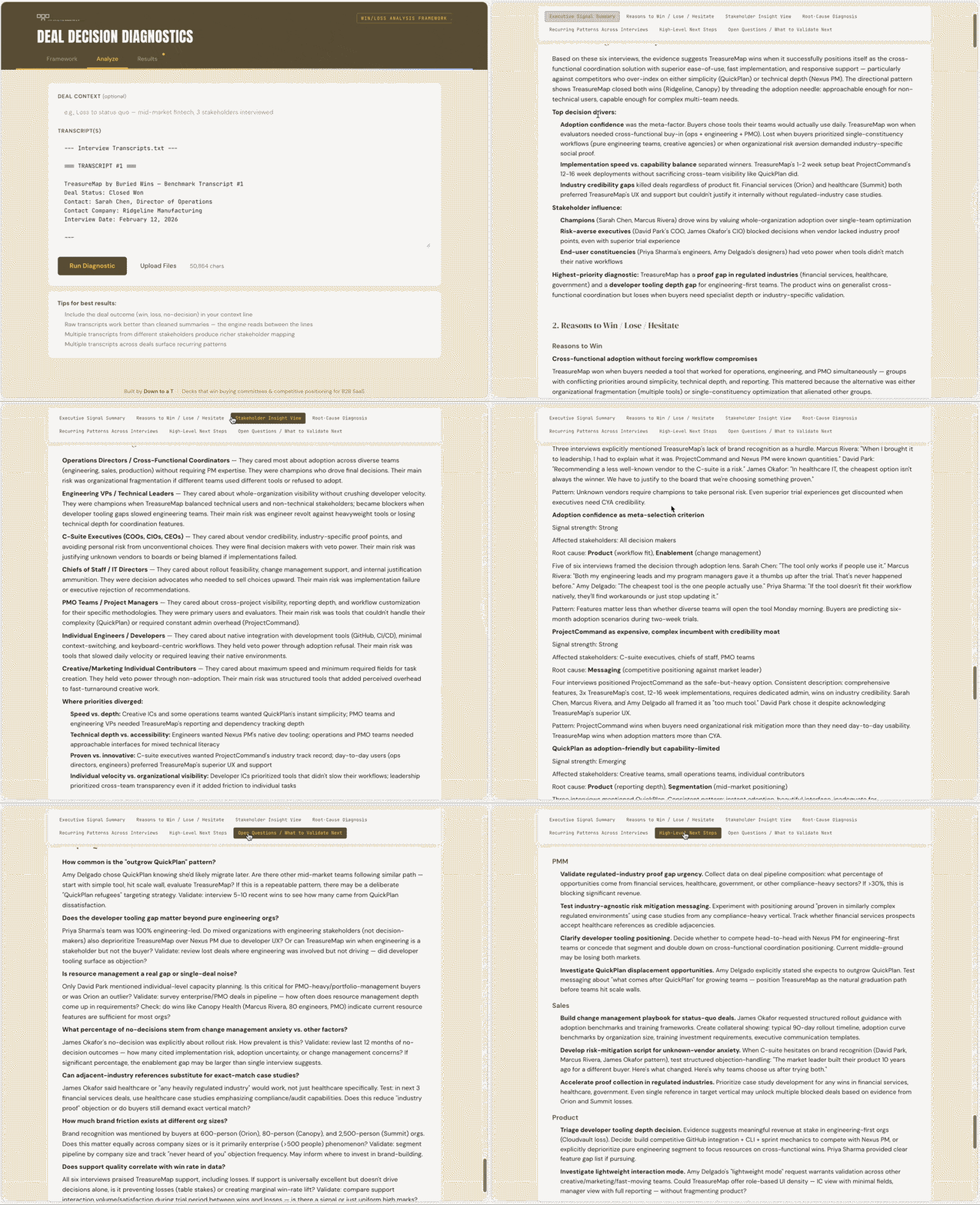
You paste one or more win/loss interview transcripts and the framework produces a structured diagnostic in seven sections:
Executive Signal Summary — top decision drivers, who shaped outcomes, highest-priority takeaway
Reasons to Win / Lose / Hesitate — grouped findings with evidence references, not just theme labels
Stakeholder Insight View — who influenced the outcome, what they cared about, where priorities diverged
Root-Cause Diagnosis — each pattern classified by category with a confidence level (high, medium, low)
Recurring Patterns — cross-interview patterns with signal strength ratings
High-Level Next Steps — directional recommendations by function, only where the evidence supports it
Open Questions — what still needs validation beyond what the transcripts can tell you
Every finding gets a confidence label. Every pattern gets a signal strength rating. Nothing gets overstated.
Try Deal Decision Diagnostics in Claude →
Five heuristics that separate useful diagnosis from theme soup
These are baked into the framework, but they're worth naming because they're the mistakes I see most often:
Frequency is not importance. A pattern that shows up in every transcript may be table stakes. A rare issue that killed one deal may be the highest-priority finding.
The stated reason is rarely the whole reason. "Too expensive" usually means the business case wasn't proven. "Too hard to implement" usually means rollout risk or a proof gap. The framework pushes beneath surface comments.
"Looked similar" is a narrative problem, not a feature problem. When buyers say alternatives looked the same, the failure is almost always in how the difference was framed — not whether a difference existed.
"Needed buy-in" means the story couldn't travel. Deals stall on "internal alignment" when the champion doesn't have a compelling, retellable story for the rooms where you're not present.
Check who said it, not just what was said. When multiple stakeholders cite different reasons for the outcome, the real driver is usually held by the person with the most decision influence — not the person cited most often.
What this doesn't do (and why that matters)
Deal Decision Diagnostics is the diagnostic layer. It tells you what kind of problem you have. It does not tell you what to say differently, what assets to build, or how to equip your champion to retell your story in rooms where you're not present.
Specifically, it does not produce:
Competitive heat maps or battlecards — because transcripts alone can't tell you how your positioning compares to what competitors are actually saying in-market. That requires separate competitive research.
Messaging recommendations — because the right message depends on your ICP's language, your competitive wedge, and your buying committee dynamics beyond what a handful of interviews reveal.
Champion enablement assets — because knowing that "the story couldn't travel" is the diagnosis. Building the retellable story is the strategy work.
Positioning strategy — because positioning requires market context, competitive synthesis, and internal alignment that no transcript analysis can replace.
This is intentional. Diagnosis without strategy is incomplete. But strategy without diagnosis is guesswork — and it's the more expensive mistake.
The framework gives you the diagnosis. When you're ready to turn that into positioning, messaging, and assets that your sales team will actually use, that's what a Complete Positioning Sprint is for.
Try it
I've published Deal Decision Diagnostics as a free, live tool. Paste your transcripts, hit analyze, and get the full structured diagnostic.
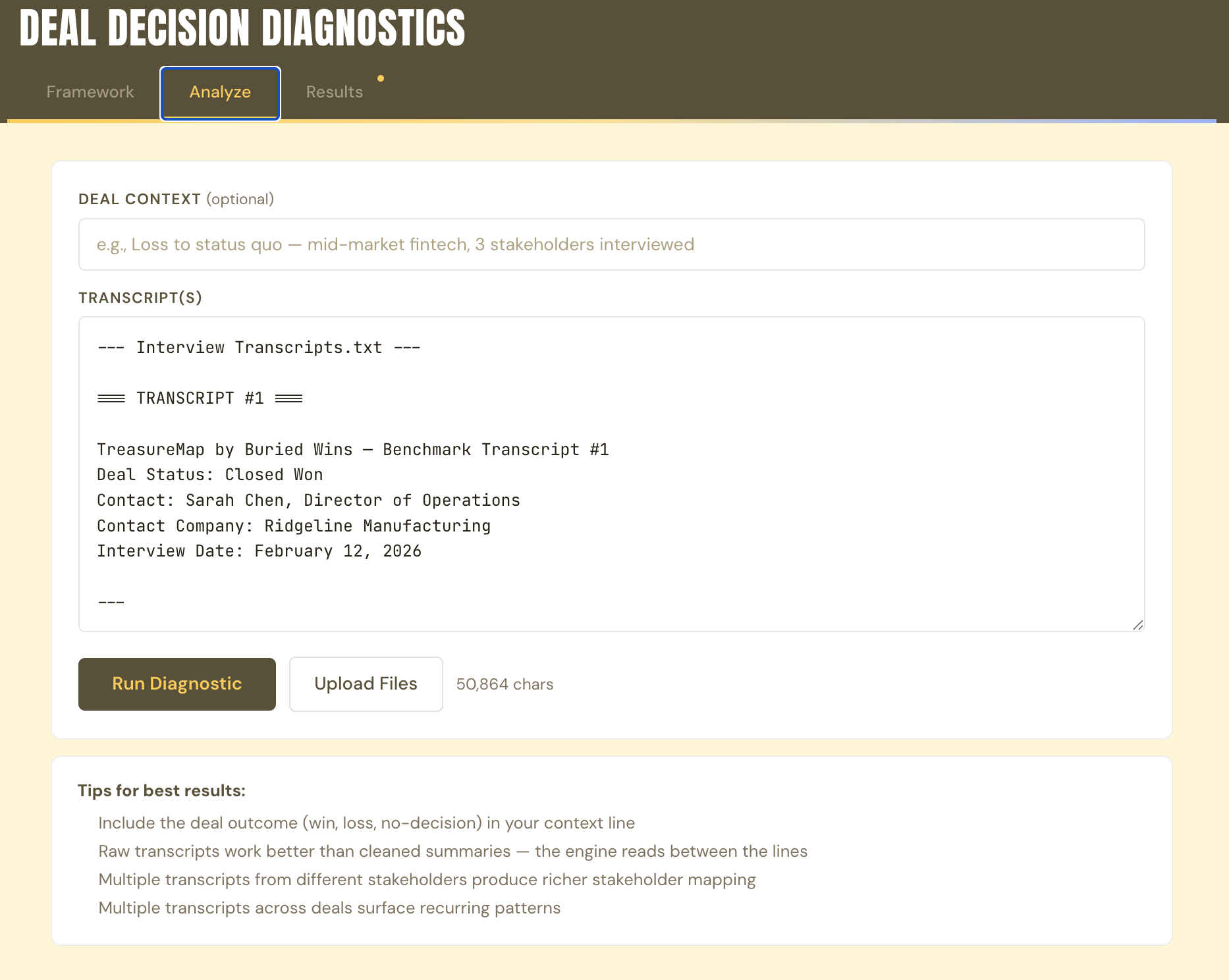
Add transcripts
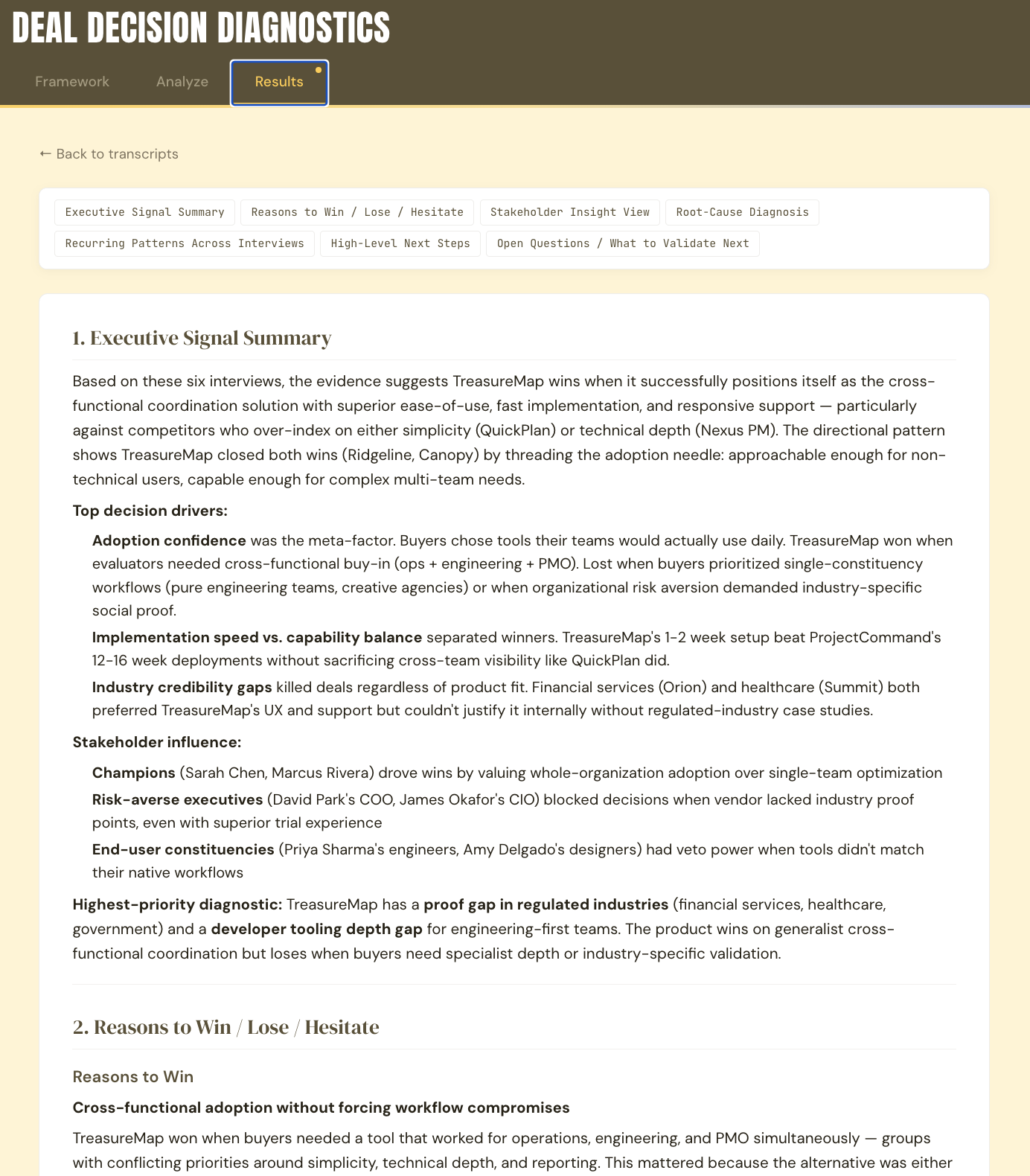
Get the analysis with easy navigation to buying committee insights, patterns, and next steps
Try Deal Decision Diagnostics in Claude →
If you've run win/loss interviews and the resulting insights are collecting dust — or worse, leading to the wrong actions — this will show you where the real problems are.
Deal Decision Diagnostics is built and maintained by Down to a T. I work with B2B SaaS companies to close the translation gap between what they say and what buyers actually hear — through competitive positioning, sales decks, and persona-specific assets that buying committees can actually use.