
Supply Chain | SaaS | B2B | Late StageA Year After Launch, Sales Reps still Couldn’t Sell the New Product.
Here’s What Changed.
The Situation
A late-stage, PE-backed vertical SaaS company had spent a year trying to sell a newly launched product. The traction was there, but deals were stalling and lost after months. Early founder-led deals had closed, but the sales team had no repeatable way to carry the conversation.
The company operated in the FMCG supply chain space, with a strong existing reputation among contract manufacturers and co-packers. The new product targeted a different buyer entirely: the CPG brand side of the supply chain—Chief Supply Chain Officers, COOs, CTOs, and CEOs at some of the world’s largest consumer goods companies.
That distinction mattered more than they anticipated.
What They Had Going In
The sales team was working from a 92-slide master deck. It had been built over time—slides added by product, by leadership, by the CEO — and it covered everything.
Reps had to self-select slides before each call, with no defined narrative arc and no guidance on what to say and when. Some slides were too high-level to explain without a script. Others were deep technical diagrams that champions could talk about for hours, but meaningless to anyone else in the buying committee.
There were no supporting assets. No one-pagers for other stakeholders. No materials designed for the CTO who needed to understand integration risk, or the COO who needed to understand operational impact, or the CEO who needed to understand strategic fit.
And there was no clear answer to the question every enterprise buyer eventually asks: why this, why now, why you?
The translation gap
The company’s existing positioning leaned on a strength that was real but misfiring with this audience: their deep roots in the manufacturer and co-packer ecosystem.
When CPG brand buyers heard “your supply chain partners are already on our platform,” they didn’t hear a reason to act. They heard a reason to wait.
The positioning wasn't wrong, but the narrative was absent. There was no story arc that took a CSCO from 'I'm fine with the status quo' to 'I need to act on this now.' The deck had true statements on every slide — but no sequence that built to a conclusion.
The logic inside the company made sense—a connected ecosystem is a genuine advantage. But the CPG brands being targeted already had relationships with those suppliers. Positioning the product as an extension of their suppliers’ platform gave procurement and supply chain leaders less urgency, not more.
There was a second gap. The problem framing relied on broad, familiar themes—global disruption, supply chain complexity—without the credible, current data to make them land. It read as background noise, not a burning problem. And without that urgency, a multi-stakeholder deal at a large enterprise had no center of gravity.
The result: champions were engaged, but couldn’t bring the rest of the buying committee along. Deals stalled at consensus.
the diagnosis
Conversations with sales, product, and the founding team surfaced the core issue: the company was not talking about what it was uniquely positioned to do for this buyer.
Their existing assets spoke to one persona fluently—the manufacturing and operations leader—and largely ignored everyone else in the enterprise buying committee. In deals averaging 17 or more stakeholders, that’s not a messaging problem. It’s a structural one.
The product had a real, differentiated value proposition for CPG brands. It wasn’t being articulated in a way that traveled beyond the champion. The deck was doing work for one person in a room full of decision-makers.
Before and after
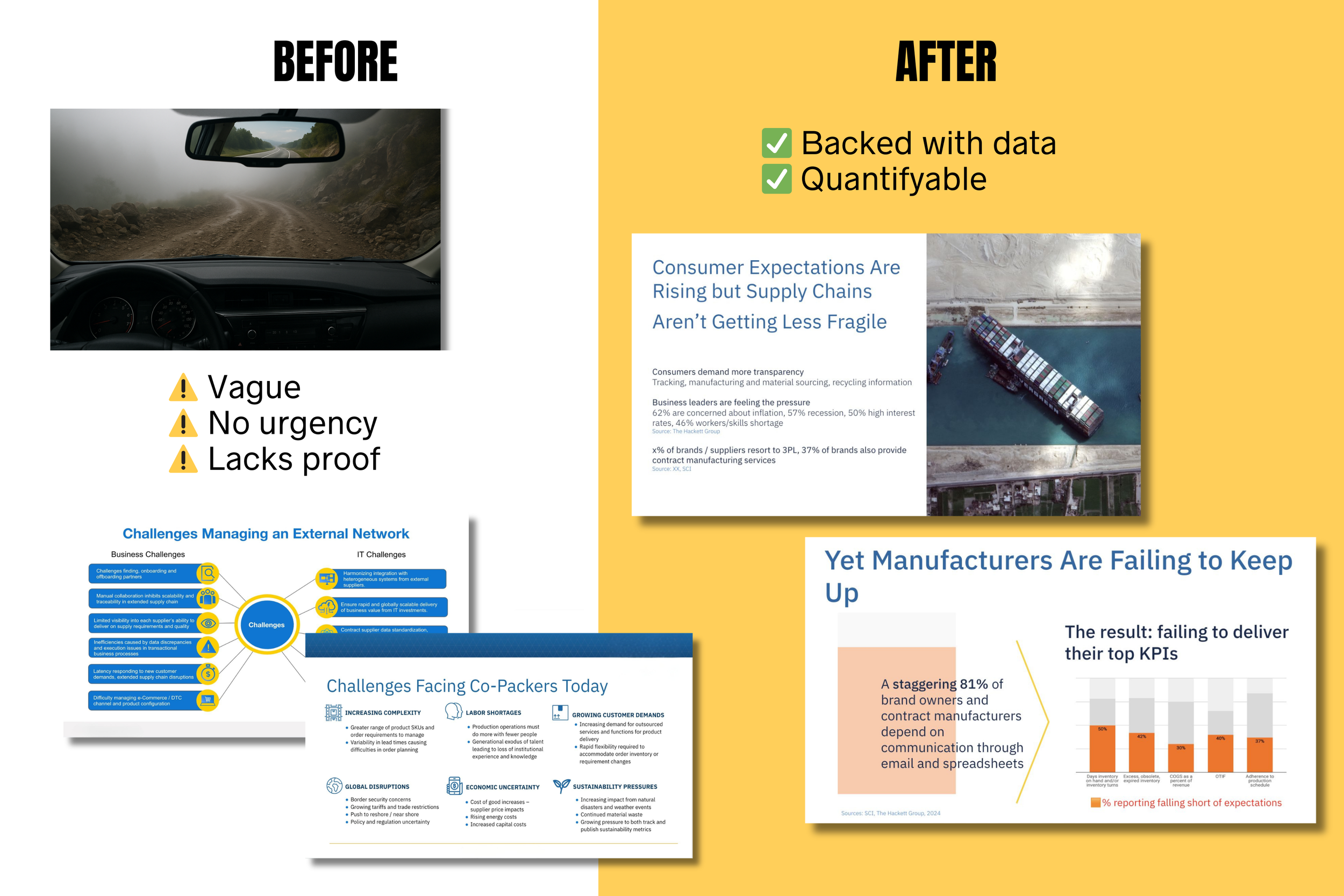
From vague market context to credible urgency
The original problem framing cited generic disruption themes with no data behind them. The new version grounded the problem in current industry research—with a clear “so what” that connected market pressure directly to KPI impact. It gave buyers a reason to act now, not later.
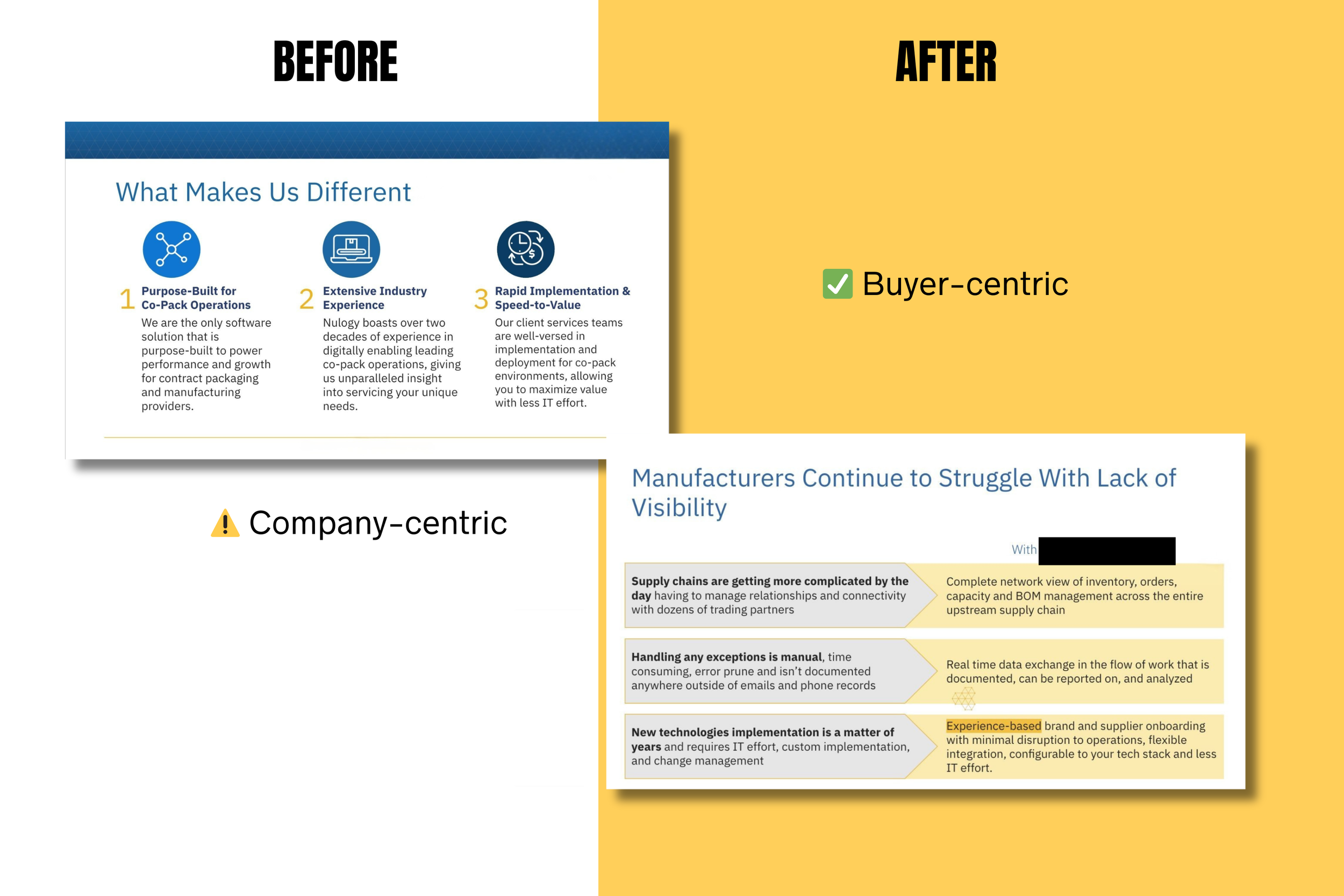
From vendor-centric to buyer-centric narrative
The original deck led with capability headers and product features framed around the solution’s strengths. The new version opened with named buyer problems—visibility gaps, manual exception handling, implementation risk—tied directly to the outcomes those problems blocked. Buyers could see themselves in the slide before the rep said a word.
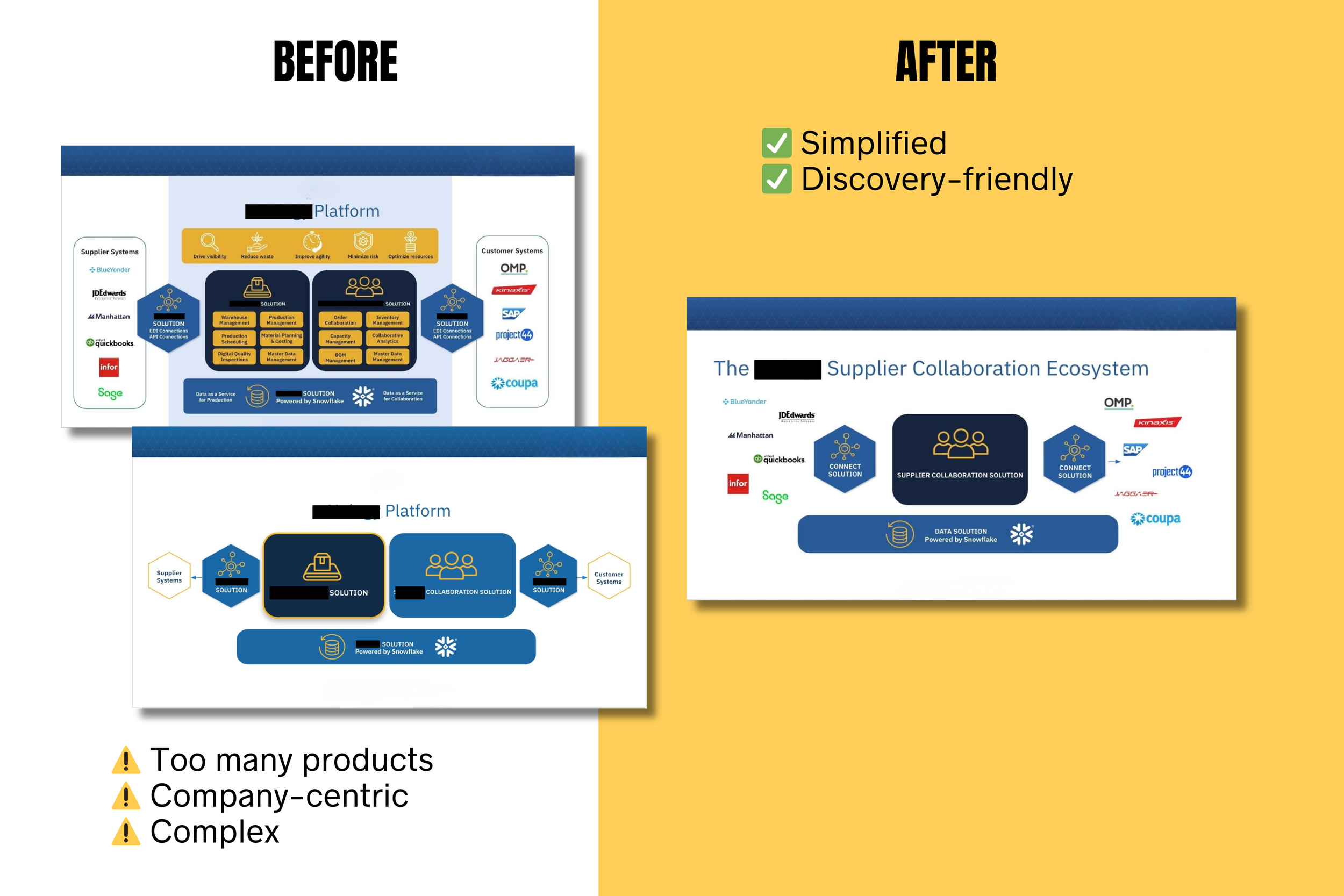
From architecture diagram to buying committee tool
The full platform architecture slide showed everything at once—all the products, modules, and every integration. It was built for internal alignment, not external selling. The new version surfaced one product at the right level of abstraction, designed to be used in early discovery to map the buyer’s tech stack. Champions could use it without the seller in the room.
What changed
Two deliverables built from a single narrative: a repositioned sales deck designed around the enterprise buyer's decision process, and persona-specific one-pagers for the CFO, CTO, COO, and CSCO — each speaking to what that stakeholder actually cares about.
The positioning work was built around the CPG brand buyer’s decision criteria—not the company’s capabilities—and designed to give every stakeholder a reason to say yes, not just the champion a reason to be interested.
The new narrative reframed the existing supplier ecosystem not as a feature, but as a risk mitigator for brands—something that reduced implementation burden and accelerated time to value. It turned the company’s strongest asset into a buying trigger instead of a reason to wait.
Industry research was added to contextualize the problem, create urgency, and establish the company as a credible expert, not just a vendor with a point of view.
What Happened Next
Sales reps were in the Google Slides before the final version was delivered. They didn’t wait to be trained on it. They asked if they could use it on their next call.
That’s the clearest signal that positioning has worked: when the people who have to sell it recognize themselves in it. And, previously stalled enterprise conversations restarted within weeks of deploying the new assets.
Beyond immediate rep adoption, the new narrative was incorporated into the company’s multi-enterprise platform messaging and press communications. It was recognized in industry awards (Top Software & Technology) and reinforced through broader platform positioning, establishing the new product not as a standalone launch but as a strategic growth pillar.
The problem was structural: the company was selling to a new buyer profile without a positioning system designed for that buyer’s decision process.
The translation gap wasn’t obvious from inside the company. The team believed the positioning was solid. The existing deck was comprehensive. The product was differentiated. What was missing was the bridge between what the company knew to be true and what a Chief Supply Chain Officer, COO, or CTO would hear in a 30-minute meeting and then carry back to their peers.