
K-12 education | Communication SaaS | B2BThe sales deck didn't exist.
Neither did the reason to switch.
The Situation
Apptegy sells a K-12 communications platform to public school districts — a strong product in a mature, crowded category where incumbents are entrenched and districts rarely switch without a crisis. Their business development team was booking calls. The challenge was the buying committee: superintendents, communications directors, IT leads, teachers, coaches — each with different concerns, most of them unvoiced. Deals were stalling because driving urgency across all of them was a challenge.
THE DIAGNOSIS
Conversations with their sales, solutions engineering, and customer success teams revealed a consistent pattern: reps were trying to articulate a reason to switch without data. They were demoing features, but features weren't making the case. Apptegy was saying true things that didn’t make the business case urgent, and missing the bigger argument that would actually land with a superintendent. The objections quietly killing deals weren't being addressed because they were never named. When I reviewed the materials in active use, the clearest signal was what wasn't there: a reason to switch without a crisis.
As Emily Simon, Director of Product Marketing, put it — the engagement helped them "feel confident in understanding their distinct product capabilities and why they matter to buyers."
They weren't short on capabilities. They were short on a frame that made those capabilities matter.
The shift
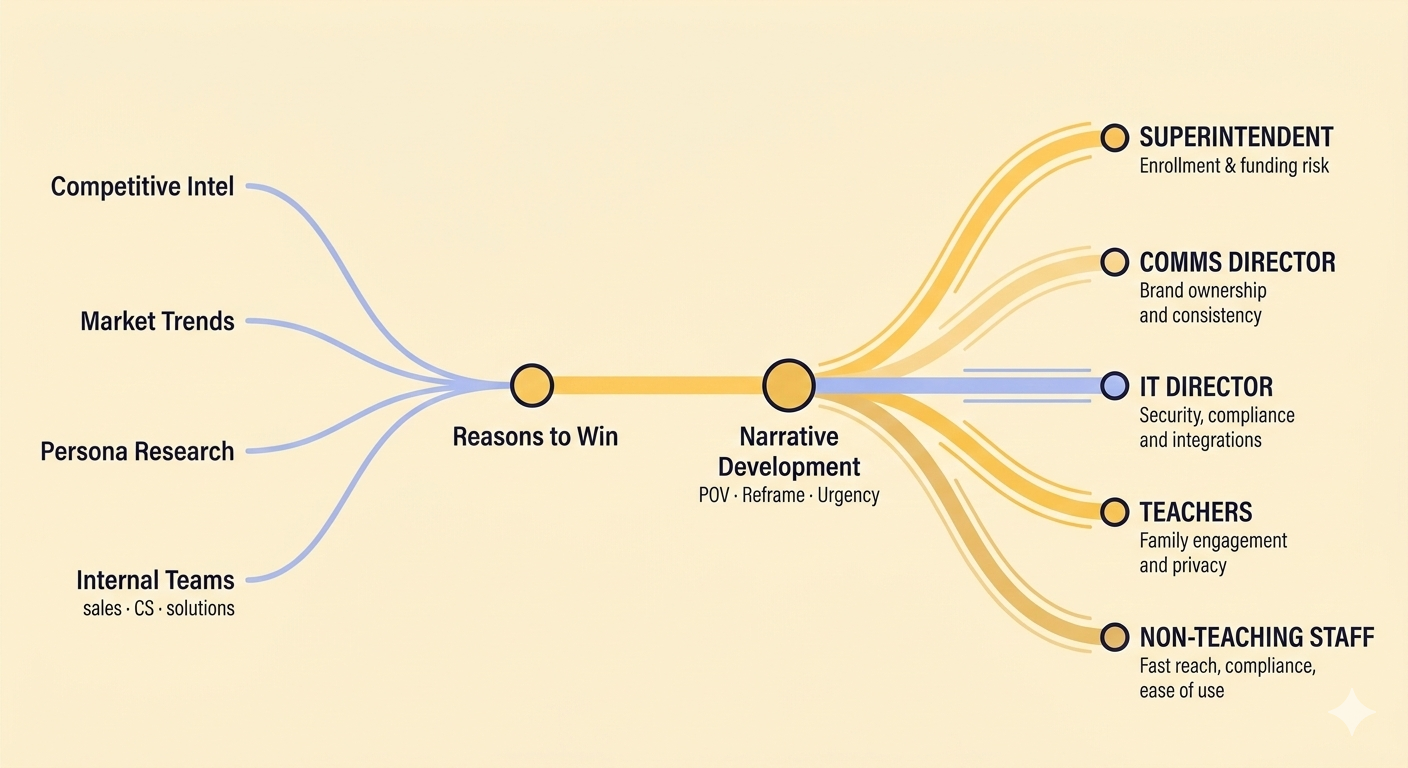
The engagement produced a Notion-based messaging system anchored in persona research, win/loss interviews, and reasons to win mapped against specific competitors. At the center: a champion deck that opened not with the product, but with a district-level business case for why switching was worth it — one built from Apptegy's own strengths, not borrowed category language. Every persona in the buying committee got their own language, including teachers and non-teaching staff whose adoption determines whether implementation succeeds or stalls.
The outcome
Apptegy's sales team — trained on Challenger, accustomed to running demos without a deck — identified the champion deck as a critical missing asset. The Notion system continues to be used for competitive campaigns, RFP responses, and marketing planning.
"Sales identified the deck as the critical missing gap," Emily said. "Her organization and ability to get up to speed on the unique market is unmatched."
before
Feature-led sales materials — platform-centric, no district-level business case, no urgency for buyers not already in crisis.
after
A messaging system and champion deck built around why the problem is worth solving now, with persona-specific language for every member of the buying committee.
why it matters
The before wasn't wrong. It just didn't make switching feel necessary.